
Bishop Hovakim Manukyan Presides at Khavaroom Service in Manchester, Leading the Faithful into the Mystery of the Lord’s Passion
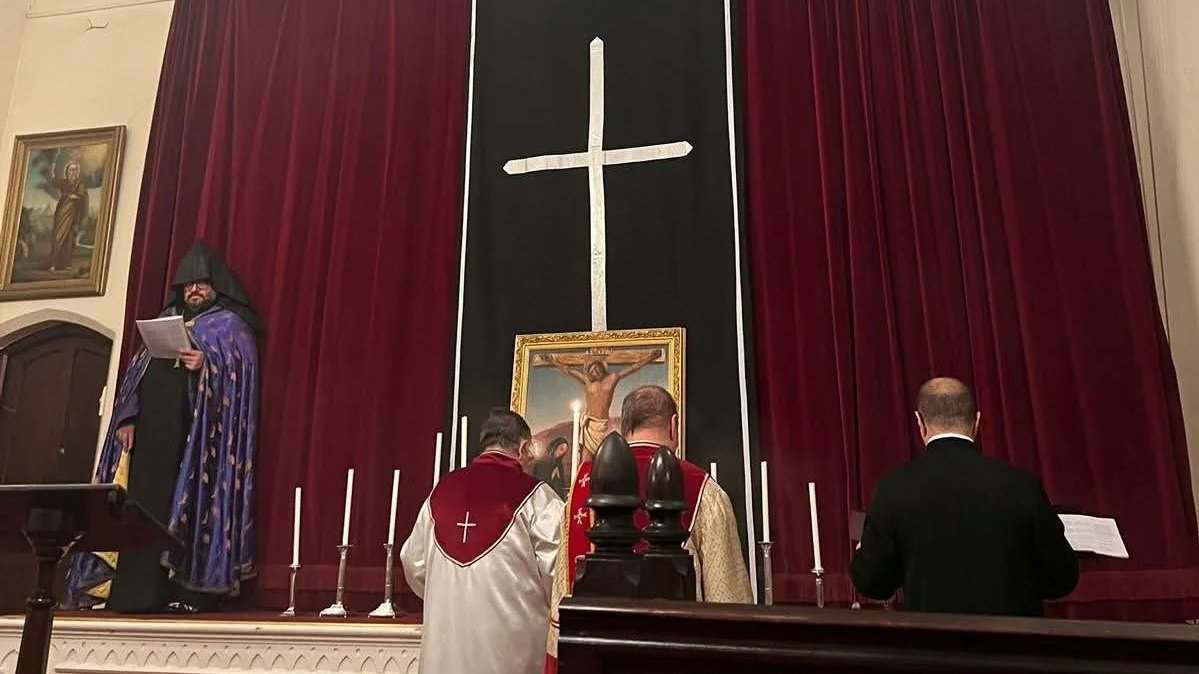
“Even in the deepest darkness, the light of Christ cannot be overcome.”
Manchester, 2 April 2026 — On the evening of Maundy Thursday, Bishop Hovakim Manukyan presided over the ancient and deeply symbolic service of Khavaroom (Vigil of Darkness) at Holy Trinity Armenian Church in Manchester, guiding the faithful into a profound encounter with the final hours of Christ before His Passion.
Rooted in the rich liturgical heritage of the Armenian Apostolic Church, Khavaroom recalls the night of betrayal, abandonment, and sorrow that preceded the crucifixion of Jesus Christ. As the service unfolded, candles were gradually extinguished, and the church was enveloped in darkness — a powerful sign of a world overshadowed by sin, and of the solitude of Christ in the face of human frailty.
At the heart of the service were the solemn proclamations from the Holy Gospel, led by Bishop Hovakim together with the deacons, recounting the events of that sacred night: the prayer in the Garden of Gethsemane, the betrayal of Judas, the denial of Peter, and the growing isolation of the Lord. In the Armenian tradition, these Gospel readings form not only a remembrance of past events, but a living liturgical act, drawing the faithful into participation in the mystery itself — to stand with Christ, to keep watch with Him, and to reflect on their own response to His call.
The service was assisted by Deacons Arthur Bobikyan and Ara Couligian, together with Hovhaness Takuqyan, whose reverent service supported the solemnity of the liturgical rite.
In his homily, Bishop Hovakim reflected on the deeper spiritual meaning of the darkness experienced during Khavaroom, noting that it speaks not only of that historical night, but of the human condition in every age. He reminded the faithful that the darkness of betrayal, denial, and spiritual sleep continues to echo in the life of every believer, calling for vigilance, repentance, and renewal.
At the same time, he emphasised that this sacred service is not one of despair. Even as the light fades, the promise of the Resurrection is already present. The light of Christ, he noted, cannot be overcome, and the Church, even in darkness, continues to proclaim hope and life.
A particularly moving moment came in complete darkness, when Tatevik Hakobyan-Otarian offered a haunting and deeply expressive rendition of the hymn “Where is My Mother”, intensifying the atmosphere of sorrow and drawing the faithful more deeply into contemplation of the suffering of Christ.
At the conclusion of the service, the faithful entered into a moment of profound adoration, offering praise to the Holy Cross and veneration to the crucified Lord. In this silent and prayerful act, the Church turned toward the mystery of the Cross — the place where suffering is transformed into redemption. The ancient hymns of the Armenian Church gave voice to this mystery, recalling the betrayal of Judas through love of silver: «Արծաթասիրութեամբ Յուդա մատնեց զՏէր». In this way, the liturgical poetry became both remembrance and exhortation, calling the faithful to examine their hearts and to turn away from all that separates them from divine love.
The service concluded in silence, leaving space for reflection as the faithful continue their journey through Holy Week — from the sorrow of the Cross to the radiant joy of the Resurrection.
Through the richness of its prayers, hymns, and sacred symbolism, the Khavaroom service remains a timeless invitation: to remain with Christ in His suffering, and, through that faithfulness, to share in the light of His Resurrection.