
The Mother See
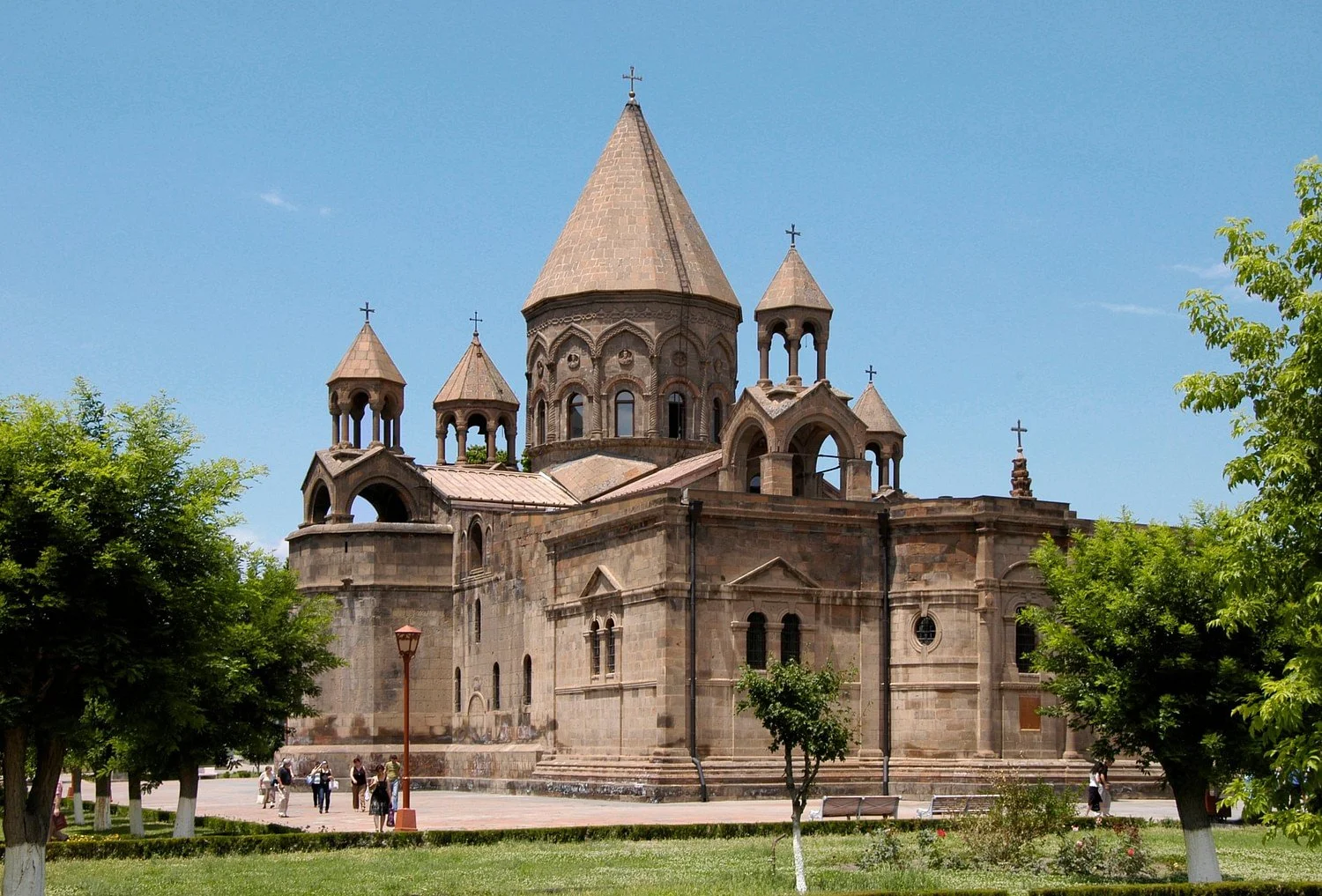
The spiritual headquarters of the Armenian Church, the Mother See of Holy Etchmiadzin, located in the city of Vagharshapat, Republic of Armenia, was established in 301 AD and, seventeen centuries later, continues to guide our devoted nation and people on the luminous paths of fulfilling the primary mission of our Church – leading people to God. The Mother Cathedral, founded by the Descent of Christ, built by St. Gregory the Illuminator and King Trdat III, has stood as a historic symbol of the Armenian faith, nation, and people.
Among its numerous museums and libraries, the Mother See is responsible for the preservation of artifacts, both those created by the Church and those given to the church as gifts over time. The most important relics of the Armenian Apostolic Church are kept in the Mother Cathedral of Holy Etchmiadzin: the Holy Lance ‘Geghard’; the Right Hand of St. Thaddeus the Apostle; the Right Hand of St. Gregory the Illuminator; the relics of the Noah's Ark and the True Cross; the relics of St. Hovhannes Karapet, Peter and Andrew the Apostles, Matthew and Mark the Evangelists; the relics of St. Gayane and St. Hripsime; the Right Hand of the Patriarch James of Nisibis; relics of the St. Gevork the Warrior.
Led by His Holiness Karekin II, the spiritual and administrative work of the Armenian Church is carried out in the Republic of Armenia in the areas of Religion, Preparation of Clergy, Christian Education, Construction of new Churches, Social Services, and Ecumenical activities.
The Catholicos
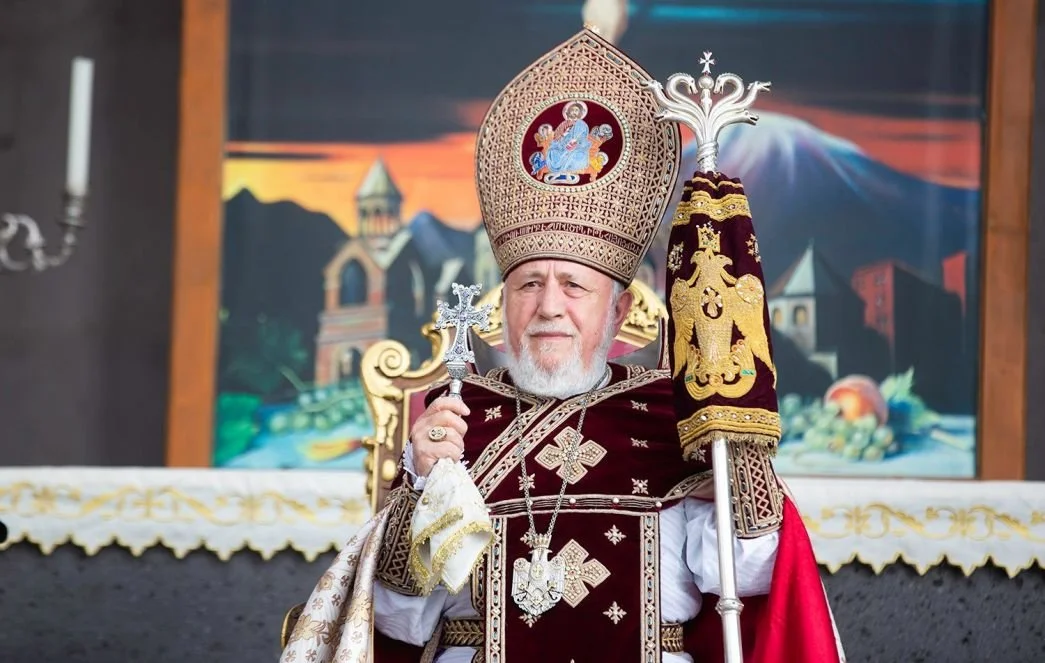
The Supreme Spiritual and Administrative leader of the Armenian Church is His Holiness Karekin II, Supreme Patriarch and Catholicos of All Armenians. He is Chief Shepherd and Pontiff to all Armenian faithful and is the worldwide spiritual leader of the Nation, for Armenians both in Armenia and dispersed throughout the world.
His Holiness Karekin II was elected to serve as the 132nd Catholicos of All Armenians in October 1999, and the years of his enthronement have been marked by progressive and energetic activities. In order to bring the life and works of the Mother See to the faithful, one of the focuses of His reign has been to make Pontifical visits to all the Armenian Dioceses throughout the world and within Armenia. To strengthen the position of Armenian communities, official receptions and visitations have been made and held with various levels of religious and world leaders, as well as government officials.
From the beginning of his Pontifical reign, His Holiness Karekin II gave great attention to the organisation of the Brotherhood of the Mother See of Holy Etchmiadzin.
The Hierarchical Structure of the Armenian Apostolic Church
The Catholicosate of the Great House of Cilicia, headquartered in Antelias, Lebanon, is led by His Holiness Catholicos Aram I.
The Armenian Patriarchate of Jerusalem, which has jurisdiction over the Holy Land and the Diocese of Jordan, is led by His Beatitude Archbishop Nourhan Manougian.
The Armenian Patriarchate of Constantinople and All of Turkey, exercising jurisdiction within the Republic of Turkey, is led by His Beatitude Archbishop Sahak II Mashalian.
These three historic hierarchical Sees administer the dioceses under their respective jurisdictions in accordance with canon law and ecclesiastical tradition. However, in all spiritual and doctrinal matters, the primacy of the Catholicosate of All Armenians, seated at the Mother See of Holy Etchmiadzin, remains pre-eminent.
In addition to their pastoral and administrative responsibilities, each hierarchical See—including the Mother See of Holy Etchmiadzin—maintains a Monastic Brotherhood, dedicated to prayer, worship, spiritual formation, and service to the Church.
Regionally, the Armenian Church is organised into Dioceses wherever Armenian faithful reside. Each Diocese is led by a Primate and governed from its diocesan headquarters. Every Diocese is composed of parishes and local communities, serving the spiritual needs of the faithful.
The spiritual and administrative bodies representing the authority of the Armenian Apostolic Church include the following:
The National Ecclesiastical Assembly
is the supreme legislative body presided over by the Catholicos of All Armenians. The members of the National Ecclesiastical Assembly are elected by the individual Diocesan Assemblies. The National Ecclesiastical Assembly elects the Catholicos of All Armenians.
The Council of Bishops
is an administrative-deliberative body presided over by the Catholicos of All Armenians. It makes suggestions on the dogmatic, religious, church, parish, and canonical issues to be discussed as agenda items during the National Ecclesiastical Assembly.
The Supreme Spiritual Council
is the highest executive body of the Armenian Church and is presided over by the Catholicos of All Armenians. The members of the Council can be elected by the National Ecclesiastical Assembly or appointed by the Catholicos of All Armenians. The Catholicos of All Armenians, His Holiness Gevorg V. Soorenian, established the Supreme Spiritual Council on January 1, 1924, to replace the Synod of Bishops.
The Diocesan Assembly
is the highest legislative (canonical) body of each Diocese and is headed by the Primate of the Diocese. The Diocesan delegates (representatives of each parish community) elect the delegates to the National Ecclesiastical Assembly, the members of the Diocesan Council, as well as discuss and decide on administrative issues within the Diocese, such as committees, budgets, building, etc. In some Dioceses, the Diocesan Assembly elects the Primate of the Diocese.
The Diocesan Council
is the highest executive power of a diocese, presided over by the Primate of the Diocese. It regulates the inner administrative activity of the Diocese under the direction of the Primate. The Diocesan Assembly elects members of the Diocesan Council.
The Monastic Brotherhood
is comprised of the celibate clergy of the monastery who are led by the Abbot. At present, there are three brotherhoods in the Armenian Church – the Brotherhood of the Mother See of Holy Etchmiadzin, the Brotherhood of St. James at the Armenian Patriarchate of Jerusalem, and the Brotherhood of the See of Cilicia. Each Armenian celibate priest becomes a member of the brotherhood in which he has studied and ordained in or under the jurisdiction of which he has served. The brotherhood makes decisions concerning the inner affairs of the monastery. Each brotherhood elects two delegates who take part in the National Ecclesiastical Assembly.
The Parish Assembly
is the general assembly of the community presided over by the spiritual pastor. The Parish Assembly elects or appoints the members of the Parish Council and the representatives or delegates to the Diocesan Assembly.
The Parish Council
is the executive-administrative body of the community. It is presided over by the spiritual pastor of the community, who takes up the inner administrative affairs of the parish and is engaged in the realization of its administrative and financial activities. Members of the Parish Council are elected or appointed at the Parish Assembly.