
19 June - Armenian Studies Lecture: Ephrem Armenius
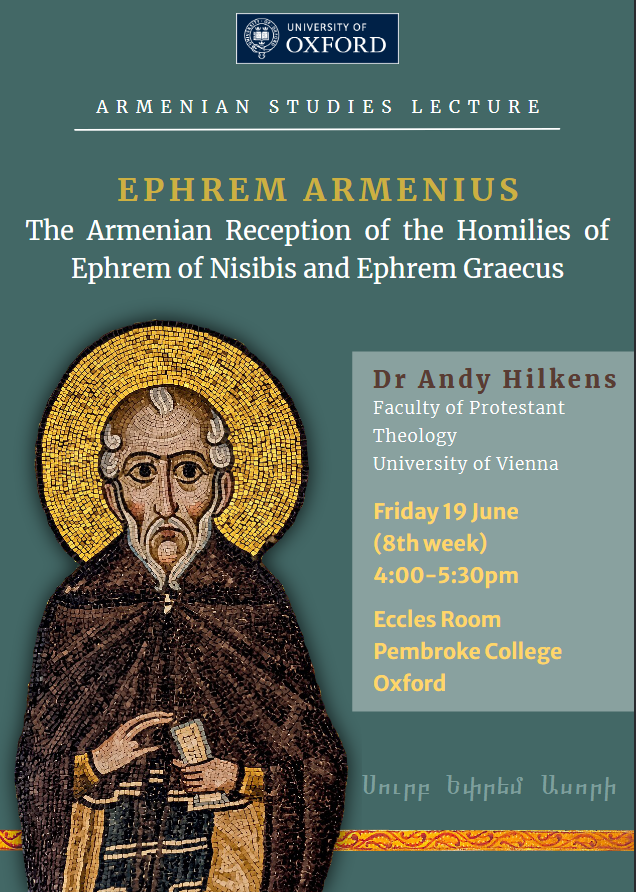
Come to the Eccles Room in Pembroke College in Oxford University on Friday, June 19 2026 from 4:00 p.m., for a second special lecture by Dr Andy Hilkens in their Armenian Studies Series: “Ephrem Armenius”.
Ephrem Armenius: the Armenian reception of the homilies of Ephrem of Nisibis and Ephrem Graecus
No Syriac author was as influential outside of “the Syriac world” as Ephrem of Nisibis. A deacon who migrated to Edessa after the Roman handover of Nisibis to the Persians in 363, he was a gifted anti-heretical poet who is the most translated and imitated Syriac author of all time. Given the early reception and imitation in Greek, which spread across Western Asia, Europe and Northern Africa in Late Antiquity and the Middle Ages, it is no surprise that the Armenian tradition, with its openness to Syriac as well as Greek culture, was enriched by both traditions. In this talk, I will explore the Armenian reception of Ephrem of Nisibis and Ephrem Graecus, focusing in particular on the formation and transmission of the heterogenic Armenian corpus of Ephremian and Pseudo-Ephremian sermons, and on the promise of the Armenian tradition for the discovery of previously unknown texts.
Dr. Andy Hilkens is a religious and cultural historian of Late Antiquity and the Middle Ages who operates at the intersection of Syriac, Armenian, Coptic and Byzantine studies. He is currently a postdoctoral researcher in the FWF-START project Generative Authority: The Followers of the Apostles as Literary Characters (PI: Dan Batovici) in the Faculty of Protestant Theology at the University of Vienna, and teaches Coptic at the Institute of Egyptology. His research interests include Syriac and Armenian hagiography, the Syriac historiographical tradition and its ties to Greek, Armenian, and Arabic historiography, Syriac- Armenian studies (in particular Syriac-Armenian dialogue and debate, Syriac-Armenian bilingualism, and the production of translations), and the global reception of Ephrem of Nisibis, Ephrem Graecus, and Jacob of Serugh.